Friday, March 27, 2015

Profile Post


Do you want to know more about video games and eSports?  With the help of Samuel Lingle, a writer for the online news outlet TheDailyDot you can. The Daily Dot is a website dedicated to presenting online news in a informative way. One of their main focuses is video games. With a focus on eSports I wanted to find someone who had relevant and interesting insight in eSports. Because eSports is relatively new in the world of entertainment, finding quality information regarding the topic is oftentimes difficult. Samuel Lingle is able to present information about eSports that is relevant to people who are into video games and people who are not. Typically a blog post on this site features a large image corresponding to the topic, This image may be a scene from an event that was featured in the article or a portrait of the topic of the blog post. Beneath this picture is the actual title of the article as well.

 For people in the U.S, getting coverage on eSports is harder because it isn't as popular as in other countries. That is where Samuel Lingle, a staff reporter of eSports comes to mind. Being a staff reporter of the site TheDailyDot, Lingle has knowledge of the competitive gaming circuit. I felt a connection to Lingle that I didn't get with other eSports blogger. Lingle's blogs would satisfy the readers desire for eSports news. If you give him a chance he will not disappoint and here is why:
1. He gives you the topics that matter, not some review about game xyz that won't connect with the readers that don't play video games.
2. Lingle makes sure that he leaves the reader with his opinion. Gives us more open thought and I enjoy bloggers point of view on eSports topics.
3. You are hard pressed to find another blogger that gives you information like Lingle. One of the only people that talks about eSports.

Samuel Lingle has been covering eSports as a job for a while now. According to his Twitter account, Lingle has been writing about video games for 12 years. His in depth knowledge covers in depth analysis of popular gaming titles such as League of Legends. He also talks about non gaming factors within the gaming world such as sexism, professional gaming and college scholarships, and sponsorships. His most recent blogs have focused on the recent IEM World Championships tournament for League of Legends held in March.  TheDailyDot website as a whole is popular among people who are interested in online news, though for most casual people of games, TheDailyDot may not satisfy their desire for at the second in depth news of particular professional games.I don't look for video game reviews anymore when searching for eSports news. The two do not go together, like oranges and apples. Lingle gets my attention for his eSports coverage and opinionated in depth analysis that I identify with. This key component makes his blogs more readable as it doesn't just offer the plain, dry neutral reporting, conventional new outlets produce.

Samuel Lingle wrote an article on TheDailyDot titled collegiate gaming to feature on ESPN's Outside the Lines. For some background, eSports has had a difficult time getting airplay on ESPN (one of the biggest providers of entertainment in sports). Recently however, ESPN has been showcasing more eSports on their networks which is nice for a change. Outside the Lines is one example of a show that features eSports. Outside the Line is a popular news series that ESPN broadcasts on their parent of networks. OTL (Outside The Lines) is an overall enjoyable show and I would recommend it to people who want to know more about the sports world. Here the discussion is Lingle discusses how eSports and college gamers are to be featured on one of ESPN's television shows. One particular line in his post that caught my attention and a opinion that I also believe in is that "ESPN certainly can't ignore esports. Even if its present thinks its just a competition." Here Lingle acknowledges that the growth of eSports is something that is important. I feel as though Lingle does not care whether ESPN's John Skipper, the president of ESPN thinks eSports is a sport. If it gets attention, then that is a win for the eSports community as a whole. He looks at the bigger picture instead of focusing on what most people for and against what eSports as a whole stands for.

Hearing people argue whether eSports should be considered a sport is tiresome now. At this point myself and people who like eSports will focus on the future. Even if people will not consider it a sport, the bigger picture according to Lingle is the growth and establishment as an alternative form of entertainment is key to longevity. Longevity means that eSports will continue to last and have opportunities to grow even bigger. Lingle with the article on collegiate gaming on ESPN, presents a topic that people within the eSports community will be interested in reading as well as people that do not traditionally follow the sport but are curious. College is something that most people identify with (i say most because even some professional gamers aren't college graduates), so this plays in Lingle's favor when writing to people. He has a point of view by mentioning that eSports has something bigger to look forward to. These components make for an interesting blog post.

Lingle also caught my attention with his article about eSports as a sustainable business.Power house sports entertainment companies doubt the potential of eSports as a whole. For example ESPN refuses to take eSports seriously even though they broadcast eSports content on their family of networks. Though it may be understandable that competitors in the entertainment sphere share their doubts over eSports, gaming developers are a group that may shock some as doubters of eSports. In Lingle's article, he expresses that game developers have not made strides in the past to incorporate competitive gaming features that benefit both parties. It is not until recently that game developers embrace eSports as a viable way to promote games and make them better for audiences. Lingle uses the classic example of the game Counter Strike which was a mod of the hugely popular game Half Life. Even though this game went on to achieve a paramount amount of success in the competitive scene, developers of the mod didn't implement professional gaming features until recently. Ignoring the idea of making a game more competitive at the cost of tweaking mechanics that may seem balanced at first overall makes the game better and the industry better.

Again Lingle reinforces his point of view that video games are not just a hobby but a viable business, which video game fans agree with. By uniting game developers, sponsors, eSports business and audiences all on the same page, eSports will become the next big thing in the entertainment industry if it hasn't already. I hadn't thought of game developers affecting the growth of eSports in the past. But after reading about Lingle, I became more aware of the issue. It made me think for once when reading a blog post, something I rarely do on other game blogging sites. The future of gaming is bright. As it continues to grow, more people will look for ways to learn about it. I believe that Lingle is a great source of information for people who are curious about video games. Lingle is someone who I think is beneficial to eSports. Esports is in good hands with his reporting.

Friday, March 6, 2015

Social Bookmarking Post

For this blog post, I will be primarily focusing on the social bookmarking experiment that I recently discovered. Since this blog is focused on video games in popular culture,I wanted to advance the research beyond just what I found through a simple Google search. By using Diigo, a website that acts as a way to share your documents with other people and edit them, I've discovered new articles that pertain to my interest. Using the keyword "eSports", I am able to see what documents other people with video game interest are reading. This method is useful to see what important eSports information other people are using and use some of it to create my own view.

When using Diigo and browsing the eSports related articles that other users have tagged (shared), one particular article grabbed my attention. This article called "The Rise of the Professional Cyber Athlete" featured a wealth of information in regards to the esports community. We all know that the growth of esports is in its infancy and the available information regarding the topic is quite scarce. I feel as though the growth of video games hasn't received the amount of attention it deserves from the media. It is commonly overcast by other media juggernauts such as movies, reality television, concerts etc. To get back to the article though, Ben McGrath, an author for TheNewYorker magazine writes about the professional gamers. What stands out to me in particular is the fact that he analyzes a female professional gamer in the beginning of the article. His description of the crowd being surprised that she was "neither South Korean nor a young man in a game called Starcraft 2 was nice to point out because many people associate video games with males.

(Note: Scarlett identifies herself as female. While looking up information about the person there is some confusion as to whether Scarlett is male or female. For all intensive purpose I will identify Scarlett as a female.)

(Note: tarcraft 2 is a popular rts (real time strategy) game where your objective is use resources scattered on a map to try and amass an army to eliminate your opponent).

The article then dives into what eSports really means and if it is a sport or not, using the quote from ESPN president John Skipper "It's not a sport. It's a competition." I cane see why this article is popular among the users on Diigo because of the amount of information that is relevant for people learning more about the eSports community. I will continue to use Diigo as a source of knowledge for my research of eSports and video games in general.

Also I will looking at the blog of Nathan Grayson from Kotaku. This person is interesting to follow because he presents information in regards to video game growth that might be interesting in the future. The article i found on the website that he wrote about RiotGames (the creator of League of Legends) being pissed at a certain streamer for streaming matches of a professional gamer was very interesting and something that I want to look more into. This story is interesting due to the factors that both the streamer and the creator of the game RiotGames have presented in arguments for why the stream should be shut down vs why it should not. Though some of the posts that i have discovered so aren't quite what I am looking for in terms of eSports, the overall content is very relevant to what this blog pertains to. As video games become more prominent in popular culture (some might argue they are right now), i am interested in seeing what Grayson has to say on this. I may also check out Reddit to see what people have to say on Video games in general. I believe that the more information I can gather, the better the blog will be content wise due to the fact that I will have opinions from multiple sources.

Friday, February 27, 2015

A Critique of the New Direction Of Gaming


So lately I have been thinking about what to write about next. I looked at a recent game entitled The Order: 1886. The premise of the game almost seems entirely made up to cater more to movie goers than actual hardcore gamers. The premise is set on a old English city around, yep you guessed it 1886. The story contains a protagonist and werewolves and vampires. The protagonist is part of a rebellion to upstart revolt against the government in place. The story isn't really what I want to focus on. Rather I want to divulge my attention on the actual game-play and the change in how games are being made today.

This game is one of many that feature the long drawn out cut-scenes that develop more on the story line than actual game play. The game plays itself out almost like a movie. The dialogue between characters reminds me of old classic movies that center around Victorian age. I feel as though there has been somewhat of a shift in the gaming community to incorporate more cinematographic imagery to try and cater to the audience. The movie industry has been one that tries to separate itself from video games, though both seem to point to virtual or alternate reality. I feel as thought he gaming developers with this game is trying to do too much in one area and not focusing enough on an area that is most important: the actual gaming itself. The gaming itself is an integral part of the gamer's experience. We can only take so many pauses in between games before we falter or get frustrated. Maybe it has to do with the adrenaline building up before an assault or the nervousness of anticipating an epic boss fight. Whatever it is, it kicks in and never gets to be expelled due to the repeated cut-scenes.

Compare that to what games were like 20 years ago. The early period of video games didn't have much of a story-line. Granted the technology was not nearly as capable of delivering the same type of finished product that is produced now, but even though there still was not really a focus on the story. Games during the early period were made simplistically with minimal detail to graphics, focusing on the core component of fun. Fun is ultimately the main goal for many game developers. To create a game that is enjoyed by a community is considered to be successful.

Side Note: Here is a link to a website which goes into depth about the game (review).
(also to note, the game looks beautiful, easily one of the most visually pleasing games to ever grace the gaming platform.)

As I return back to the game The Order 1886, I wonder if this new take on movie dialogue and less emphasis on actual game play content is going to push gamers away from future endeavors in the gaming world. The Order 1886 was a highly publicized and hyped game, receiving coverage from E3 (a popular gaming convention featuring the newest games to hit the market in the future). Critics have been harsh and have also recognized the shortcomings of the game play and the obvious attention to graphics and cut-scenes. Do not get me wrong, when I first saw the game I was also one of the many who was anticipating the game to be groundbreaking in its graphical delivery and masterful storytelling. Instead I ended up after seeing and demoing the game a bit, a lackluster game that falls short. I applaud the developers trying to push the boundaries, but in doing so they should make sure to keep game play experience as a forefront. Hopefully the video game industry in the future takes a good look at the flaws the game suffered and focus on them to deliver an even better game in the future. I also hope that the game developers do not forget to focus on making sure the game is ..... well a game and not try to make it something that it is not (movie-esque) which I felt The Order 1886 unfortunately did.

Friday, February 13, 2015

10.9 Million Dollar Prize Pool

As I continue with the trend of video games for this blog, one aspect to look at is the professional side of video games in popular culture. I will begin by talking about the rise of tournaments from players trying to obtain top scores to tournaments last year which had millions of dollars in prize money. So according to Kotaku, the first known video game tournament was held at Stanford University. This tournament featured the game SpaceWar, with the first place prize being a year subscription to Rolling Stones....  (no consolation prize for second place either, though there was free beer).You can read more about it here. Also here is a picture of the game which is played on a outdated piece of technology:


 For your information, a yearly subscription of Rolling Stones in today's monetary value is $29.95 according to Amazon. That isn't too bad considering that back then there weren't digital publication of magazines and people actually read physical magazines. Still even if you were to move the time value of money on that 1970's subscription of the Rolling Stones to today it wouldn't be that much. Prize pool in video games is a way to tell just how much the growth of professional video games have grown in recent years.

Now fast forward 42 years to 2014. I've mentioned before about the game League of Legends. You might be asking why i am bringing up this game. The reason i bring up this game is because of the prize pool which was 2.1 million dollars. Lets recap what we have so far. 1972, winner gets 12 issues of a magazine worth 30$. 2014,first place in League of Legends Esports video game tournament gets 1,000,000 dollars which is equivalent to 3333 subscriptions of Rolling Stone Magazine. Quite the leap, but that isn't even the jest of things. Yes of course with prize money there is going to be a tax on it, 40%-50%, but still even with a split of 1,000,000$ which will be split four ways, each person is going to be walking home with a 100,000$+. The funny thing is, this isn't even the largest prize pool for a video game tournament in esports history. That record belongs to the International Dota 2 event of 2014. This tournament had a prize pool of 10.9 million dollars (the Compedium is a fancy name for the championships of Dota 2)!!! First place received a grand prize of 5.6 million dollars. Millionaires were literally made during the grand final day. An interesting thing to note about this is that the part of the tournament was funded by the Dota 2 community. An innovative feature for fans of the series was the use of Compendium, which allowed fans of the series to purchase special prizes with a portion of the money contributing to the overall prize pool of the Dota 2 tournament. The benefits of this increase is the benefit reward strategy of being able to actively contribute to a company that you support while reaping in the added benefits of in game items. League of Legends has commented about this idea saying that "they were not concerned from a business perspective because they want to keep the prize pool at a amount that has the opportunity to grow over the years. This point of view is respectable in the sense that they don't want to alienate their fan-base by having down years which could apply if the community didn't contribute high amounts each year. The competition between these two games to of "whose prize pool" is good for everyone. It brings competition and driving forces into an already growing industry.

Essentially what I am trying to get out of this is the idea that the community itself is one of the main factors of why the video game industry is so successful. The gaming industry is one of the few industries which allow its fans to make an impact on the overall success. Free to Play, another recent strategy allowing people to "purchase" the game for free. I am sort of rambling at this point but this point is definitely not one to overlook in the future. The argument of whether to offer a game at a retail price or allow for people to purchase it for free will have an effect on whether the game will be successful in the future. Adios.

Friday, February 6, 2015

Sexism and Video Games?

     For my next blog, i wanted to tackle the controversy recently surrounding sexism in the video game industry. An example of sexism is the recent GamerGate escapade that is ongoing.  For those of you that do not know, Gamergate is  "an online movement ostensibly concerned with ethics in game journalism and with protecting the 'gamer' identity" according to gawker. The recent issue was somewhat shocking to myself because among the other video gamers around me, none really talked about this issue. A basic history of the Gamergate controversy and why sexism is involved revolves around the story of Zoe Quinn, a female game developer who developed a game called Depression Quest. You can try out the game for free here. I was one of the brave few who ventured to the website to try out the game. Basically you point and click dialogue boxes as events unfold on separate page windows. Zoe Quinn's game immediately drew criticism from the gaming community, initially because of the context of the game. You don't have any sort of game mentality (example of this would be something like vehicles or guns or puzzles to solve or a open world to roam). Instead you only have the text in front of you and the music which plays throughout the game. Another reason why she received backlash is due to her perceived notion of depression. People did not appreciate the fact that she made a game that dealt with a sensitive topic that resonates deep within the gaming community. 

     Now here is when the issue gets interesting. A group of "gamers" united under the hashtag #Gamergate, which is a reference to actor Adam Baldwin's twitter response tag to  critical videos of Quinn, the developer of the game Depression Quest. The group attacked a number of females including Brianna Wu and Anita Sarkeesian. Sarkeesian is a feminist who critiqued the sexism felt in the game community. Subsequently she was threatened by the Gamergate community and had to an event because of the possibility of harm. The irony in this idea is that while females were targeted by Gamergate for advocating the idea of sexism in the video game community, male figures who spoke out against Gamergate were not specifically targeted. One prime example is Chris Kluwe who is a professional American Football player. When he spoke out against the issue the GamerGate community did no pursue him like they did Quinn and Wu. There is no specific reason why they didn't target male figures who were opposed to the ideology of GamerGate, but speculation is that it was because they were male. To some this would count as an act of misogyny.


     The reason I bring this up, is the fact that this issue surrounding misogyny. Sexism in the gaming industry is a topic that many people consider to not exists. To me there are themes of it in the real world, especially when people threaten female game developers.I feel as though as video games grow, this issue will have to be dealt with. To me there is obviously a issue if people keep constantly bringing it up all over social media. More so if sexism is something that is an issue in the video game community, then for it to be dealt with in the future. I also urge the gaming community to take a look at what they say. If we think about what we say it may have a better impact than just blatantly saying your going to kill them. Video games were something that is fun, the passion , the social interaction and the entertainment is something that needs to be preserved. Not trying to be a white knight or SJW (social justice warrior) by the way. Also the game is not that great (talking about Depression Quest).

Friday, January 30, 2015

More Information Regarding Growth of Video Games

Cool image to grab reader's attention:
credit: ObsoleteGamer.Com


While trying to come up for a topic to write about involving video games, I thought to myself about experiences I had as a kid playing them. Some of my best memories involved playing the original Nintendo 64 with my brothers. For those of you that don't know what a Nintendo 64 looks like here you go..... This entertainment device was revolutionary for its design and more importantly because you could finally play 3-d version of MARIO!!!! (kidding of course).. For me video games was one of my early passions and I did everything in my power to experience this. I also remember purchasing a magazine called TipsnTricks ™ that contained a wealth of information on how to successfully complete an objective with their in depth guides as well as a section dedicated to cheats for those who wanted the easy way out of situations. I recently wondered what happened with this publication a few months ago and to my surprise the publication had shut down a few years ago. Time really does pass.... One of the aspects that is greatly overlooked when discussing the rise of vdeo games in popular culture, is its rise in physical publication sector. Especially with publishing of magazines such as TipsnTricks and GameInformer to name a few. Each of these magazine publications grew and at one time you could fin all these on newsstands all across America and all over the world. Stores such as Borders and Barnes n Noble.

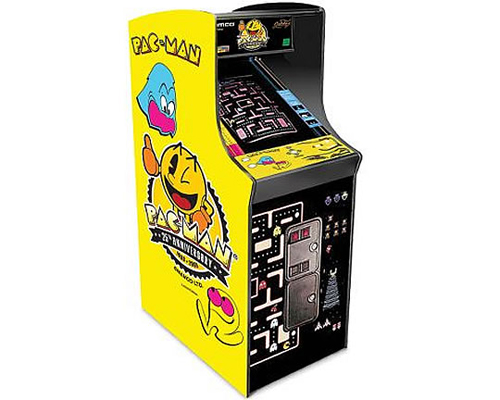
Another form of video gaming during my youth was arcades:
 I guess now Arcades are about as ancient as Dos computers, but when i was younger this was a popular and diverse form of entertainment. The impulse experienced by people to play games using quarters which for them seems like change was a great way for both video game publishers to get their product out and for businesses to capitalize on a demographic of young people. For these people change is easily accessible. This form of video gaming which peaked in the 80's and 90's is a dying breed now, with only a handful of the arcades still existing. I feel as though this cultural existence helped grow video games in popular culture. Iconic scenes in 80's movies featuring the freshly painted cabinets are the iconic visions that carry forward into the next generation.

Another aspect I wanted to touch on that many people are unaware of is the growth of video games in the cable television industry. Television shows specifically targeting video games grew in the 2000's with some being Cheat! (not to get confused with Cheaters, another television show that ironically was broadcast on the same television network), X-Play, and Attack of the Show (most people only remember this show because of Olivia Munn), With the help of the media networks, video game popularity increased. I am mainly referring to the U.S, though foreign countries across the world may have more networks that cater to video game enthusiasts. If it weren't for the fact that these shows were only shown on lesser known cable networks (g4.tv), the possibility of seeing this type of growth in video games would have happened sooner. Lastly I leave you with a link to a blog by the New York Times called "Bits" with some more information about the growth of the video game industry. Even people in business are not exactly right when referring to the growth of video games. 70 Billion by 2015?!?... More like 90 Billion in 2014.

Blog 2: The Annotated Post About Growth in Esports

For the second blog post, I have dove into the Esports aspect of video games. With my theme being the growth of video games in popular culture, one avenue to take would be discussing the professional gaming aspect of video games and growth of the audience in gaming. The annotated bibliography below summarizes key points from an article on Esports.
"Soaring eSports Viewership Driven by Online Video Platforms." EFYTimes.com Jun 02 2014ProQuest. Web. 25 Jan. 2015
     http://efytimes.com/e1/139983/Soaring-eSports-Viewership-Driven-By-Online-Video-Platforms 
This article explains the rapid growing cultural phenomenon known as Esports, or electronic sports (mainly computer gaming). EFYTimes, a technology focused publication based out of New Delhi, India  explains the rapid growing audience behind professional gaming. One of the initial points made in the article explains that the hours of Esports video consumed in 2013 was 1.3 billion compared to 2.4 billion in 2014. The term Esports video refers to "live on-demand programming that presents organized gaming competitions" according to Information Handling Services (IHS).The article also mentions the different media outlets people are using to stream Esports including the popular online streaming websites such as YouTube and Twitch which create advertisement avenues for businesses of both gaming and non gaming related sectors. The article also mentions that the audiences for Esport events are data rich, they are broadcast internationally and are live. Spearheading the reassurance in the claims that Esports video is growing and successful, EFYTimes uses data obtained from IHS when mentioning that Esports video will be worth 300 million by 2018. The article promises that the future will be bright in Esports with growth in its audience.

Hello World. Welcome To A Blog On Video Games!

Credt:playbuzz

Many people have had the question of "what I want to be when I grow up thrown at them." I myself have had this same question asked during my childhood and couldn't think of an answer off the top of my head. I remember telling my parents around the time I was four or five that I wanted to become a "professional gamer." The idea was conceived from the moment that I played my first gaming console "the Nintendo 64." (for those of you that are too young to remember Nintendo 64, just think of Mario and Luigi, and yes we had to blow on the cartridges to get the games to work). Many of you will know the answer that would come forth from my parents mouth, so I won't bother you with what came next. Let's just say it wasn't the most supporting response that they have given me. My dreams of becoming a professional gamer were shattered, but now looking back on that time, I wonder "hmm, was it really fair for them to say that professional gaming was unrealistic?" 
The growth of video games has been steadily rising since the adaption of local area networks and technology. An example of a game that has blown up the video game industry is League of Legends.If you are unfamiliar League of Legends is one of the most popular MOBA (multi-player online battle arena). The 2014 League of Legends World Championship possessed the sweet prize pool of 2.1 million dollars with the winning team taking home a cool million dollars (of course there is the loss from taxes and such).
An example of the Professional Gaming. The game involved here is League of Legends.

Even with the taxes though the revenue generated from video games is staggering. I can remember large gaming events such as EVO years ago where the prize pool was only a fraction of what it is today. The international appeal from the gaming industry from all across the world has helped the video game industry transition smoothly and have success even in times of economic distress.Video games has always been a favorite pastime of students in the engineering department of my school, including myself. With the growth of online digital media (YouTube, Vimeo), accessing an audience as a professional gamer/game developer has been easier than ever. Some of the highest paid YouTube up-loaders such as PewdiePie, make millions from talking to a computer screen while playing a game if taken literally. Twitch which was once considered a unknown streaming website and potential failure to many, is quickly becoming one of the most watched streaming website in world. Amazon recent purchase of Twitch for $970 million dollars confirms that video games are a force in the business world. Video games are versatile. They can be educational, fun or a combination of both. But this is only the surface. What does the future hold for video games. The possibilities are endless. Could we see Nobel Peace Prizes, full length feature films or virtual reality gaming in the future? Only time will tell.
In this blog I will explore the growth of video games in popular culture. For what was once regarded as silly waste of time, video games are now building a reputable base. The primary focus of this blog on how video games are growing in popular culture by examining the trends that are making it grow. These trends include the rise of professional gaming, the marketing and business that has grown within the video game industry, the trials and tribulations that video games faced. Ever wanted to know what exactly the term Esports is and why business such as Intel, Amazon, and Microsoft are investing hundred of millions of dollars in this industry?  As a industrial engineer who loves video games I feel as though this is suitable and perhaps will get more people interested in the world of video games. These and other topics will be discussed here. So if your interested in a growing industry that looks promising in the future and want to learn how it got there and where it will go from here, then sit back, relax and divulge into possibly the coolest video game blog out there (not really but still I needed something catchy to close this introduction).